 Dr Peter Santa Maria, MD, PhD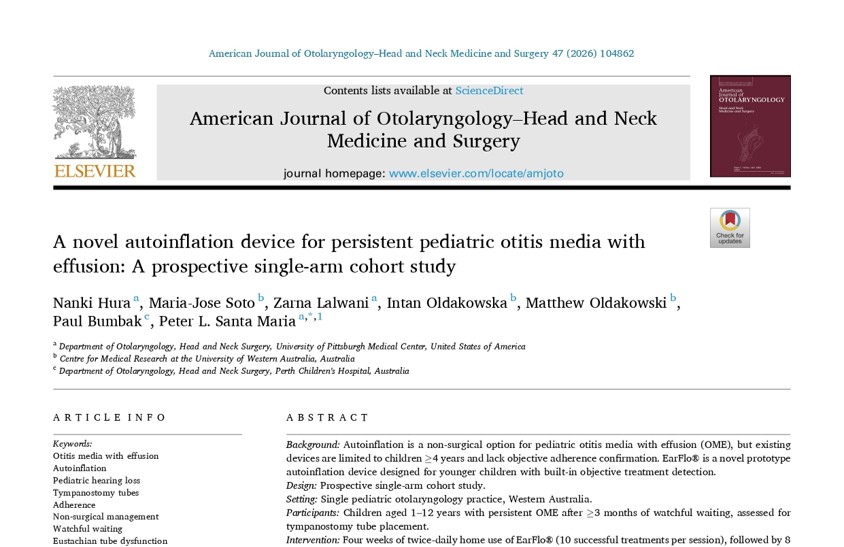
A peer-reviewed clinical study just published in the American Journal of Otolaryngology confirms that swallow-synchronized autoinflation with Earflo can help children avoid ear tube surgery, with results that may surprise even families already scheduled for the operating room.
Key Takeaways
- 89% of children indicated for ear tube surgery avoided surgery after using Earflo
- Mean hearing improvement of 12.9 dB (enough to make sounds seem more than twice as loud)
- 91% of ears showed objective middle ear pressure improvement on tympanometry
- 99% median compliance (measured by app, not parent report)
- Works in children as young as 2 years old
- No adverse events recorded
What Is Ear Tube Surgery and Why Does It Matter?
Ear tube surgery, known medically as tympanostomy tube placement, is the most commonly performed ambulatory surgical procedure in children in the United States, with over one million procedures performed every year.
Most children reach this point after months of otitis media with effusion (OME): fluid trapped behind the eardrum that causes muffled hearing, speech delays, and repeated failed school hearing tests. Current guidelines recommend watchful waiting for up to three months before considering surgery. During that waiting period, families have had very little they could actually do.
That is beginning to change.
What Did the New Study Find?
The study enrolled children as young as two years old who had already been indicated for ear tube surgery. Rather than proceeding directly to the operating room, families used Earflo, a new “swallow-synchronized” autoinflation device, at home twice daily for four weeks.
*A 12.9 dB improvement in hearing is clinically meaningful. It is the difference between hearing speech clearly and hearing it as though through a wall. For a child learning language, that difference matters every single day.
What Is “Swallow-Synchronized Autoinflation” and How Is It Different?
Most people are familiar with the Valsalva maneuver — pinching the nose and blowing hard to pop the ears. This works by forcing air up the Eustachian tube against resistance. It requires significant pressure, can be uncomfortable, and is nearly impossible for toddlers and young children to perform correctly.
Earflo uses a fundamentally different approach: swallow-synchronized autoinflation.
The Eustachian tube opens briefly and naturally during swallowing. Earflo delivers a gentle, precisely controlled puff of air coordinated with that swallowing moment — when the tube is already trying to open. Because the tube is opening rather than being forced, the pressure required is much lower, the sensation is minimal, and there is no risk of forcing air or fluid into the wrong direction.
This mechanism is why Earflo works in children as young as two — an age group that previous autoinflation devices could not reliably reach.
Why Does Compliance Matter So Much in OME Treatment?
One of the most common criticisms of home-based therapies is that families do not actually use them. In research studies, compliance is often self-reported by parents — which tends to overestimate how consistently a device was used.
This study measured compliance objectively through a built-in app that logged every use. The result was 99% median compliance — meaning families genuinely used Earflo as directed, twice daily, for four weeks.
That finding matters because it tells us the results reflect what real-world use looks like, not ideal-conditions use. When families use Earflo consistently, 89% of children avoid surgery.
How Does This Fit With What We Already Know About Autoinflation?
This is not the first study to show that autoinflation can help children with OME. A 2023 Cochrane systematic review of autoinflation, the gold standard of evidence reviews, found that children receiving autoinflation experienced improvements in quality of life and fewer children had persistent OME during follow-up.
What the new American Journal of Otolaryngology study adds is specific, rigorous data on Earflo’s swallow-synchronized mechanism in a younger age group than previous research has studied, with objective compliance tracking and formal audiometric outcomes.
It also builds on an earlier feasibility study published in OTO Open (2025), which reported 89% surgery avoidance in 21 children after a single clinical session followed by four weeks of home use.
Two peer-reviewed studies now support the same core finding.
What Does a 12.9 dB Hearing Improvement Actually Mean for My Child?
Parents sometimes struggle to interpret hearing test numbers. Here is a practical way to think about it.
Children with untreated OME commonly hear at around 25 to 30 decibels of hearing loss, which is roughly equivalent to wearing foam earplugs continuously. They can hear that sounds exist, but speech becomes muffled, details are lost, and following a classroom conversation becomes genuinely difficult.
A 12.9 dB improvement moves a child meaningfully toward normal hearing range. In practical terms, sounds may seem more than twice as loud, making speech easier to hear and understand. It is the difference between hearing a conversation as though through a closed door and hearing it clearly in the same room. For a child at a critical stage of language development, that difference has long-term implications for speech clarity, reading skills, and classroom confidence.
Who Is Earflo For?
Earflo is FDA cleared to treat negative middle ear pressure, a condition associated with Eustachian tube dysfunction that can lead to Otitis Media with Effusion. The published Earflo studies evaluated children with OME, including children during the watchful waiting period and children who had already been referred for ear tube surgery. These findings may therefore be particularly relevant for children with OME who are being monitored before surgery, children with recurrent middle ear problems following ear tube extrusion, and adults experiencing Eustachian tube dysfunction, ear pressure, or muffled hearing.
Is Earflo Safe for Young Children?
Safety was a primary outcome of both published Earflo studies. No adverse events were recorded across either study, and no child experienced worsening of their condition.
Because Earflo uses swallow-synchronized autoinflation rather than forced blowing, the pressures involved are lower than those generated during normal nose blowing. The device is designed with a child-friendly interface that makes correct technique achievable for children as young as two, reducing the risk of incorrect use.
Because Earflo works by gently equalizing pressure in the middle ear, it may not be appropriate for children with certain ear, nose, or medical conditions. Families should speak with their doctor before using Earflo if their child has had recent eye, ear, or nose surgery, or has experienced ear trauma.
Earflo should not be used in children with a perforated eardrum, active ear infection, severe nasal congestion, or a bloody nose. Children with fever or intense ear pain may have an active ear infection and should wait until these symptoms have fully resolved before starting treatment.
What Does This Mean for the Watchful Waiting Period?
Current clinical guidelines recommend a three-month watchful waiting period before considering ear tube surgery for children with OME and hearing loss. This period exists because many cases of OME resolve spontaneously but it also leaves families without anything active to do.
Earflo was designed to fill exactly this gap. Rather than waiting passively for fluid to clear on its own, families can actively support Eustachian tube function at home during the watchful waiting period.
The published evidence now supports using Earflo during this window. Families who use it consistently may find that surgery is no longer necessary when they return for their follow-up appointment.
Frequently Asked Questions
Can Earflo replace ear tube surgery?
In 89% of children in the published study who were already indicated for surgery, Earflo use meant surgery was not recommended at the follow-up visit. However, some children will still need surgical intervention, and the decision should always be made with your child’s doctor based on their specific circumstances.
How long does Earflo need to be used before results show?
In the published study, tympanometric improvement was measurable after the very first session in many children. Meaningful hearing improvement was documented at two weeks and four weeks of twice-daily use. Consistent daily use produces the best results.
Is Earflo covered by FSA or HSA?
Yes. Earflo is eligible for purchase using FSA and HSA funds. It is also FDA cleared as a medical device.
What age can children start using Earflo?
The published studies enrolled children as young as two years old. Earflo’s swallow-synchronized mechanism makes it suitable for younger children who cannot perform the forceful blowing required by other autoinflation devices.
Where can I read the published study?
The study was published in the American Journal of Otolaryngology, 2026. The earlier feasibility study is available here.
References
- Soto MJ, Hura N, Oldakowska I, Oldakowski M, Bumbak P, Santa Maria PL. Feasibility of a Novel Autoinflation Device to Treat Pediatric Otitis Media With Effusion At-Home. OTO Open. 2025;9(2):e70128.
- Hura N, Soto MJ, Lalwani Z, Oldakowska I, Oldakowski M, Bumbak P, Santa Maria PL. A novel autoinflation device for persistent pediatric otitis media with effusion: A prospective single-arm cohort study. Am J Otolaryngol. 2026;47(4):e104862
- Webster KE, Mulvaney CA, Galbraith K, et al. Autoinflation for otitis media with effusion (OME) in children. Cochrane Database Syst Rev. 2023;9(9):CD015253.
This article is for informational and educational purposes only and does not constitute medical advice. Always consult a qualified healthcare provider regarding your child’s specific situation.
About the Author
Dr Peter Santa Maria, MD, PhD
Professor & Division Chief of Otology and Neurotology
Vice Chair of Translational and Clinical Research
University of Pittsburgh
Dr Santa Maria is an Ear Nose & Throat (ENT) surgeon-scientist specializing in advanced ear disease, hearing loss, and Eustachian tube disorders.
Disclosure: This article was written in connection with Earflo, an FDA-cleared device for negative middle ear pressure. Dr. Peter Santa Maria is a co-inventor of Earflo and holds equity in the company.