 Dr Peter Santa Maria, MD, PhD
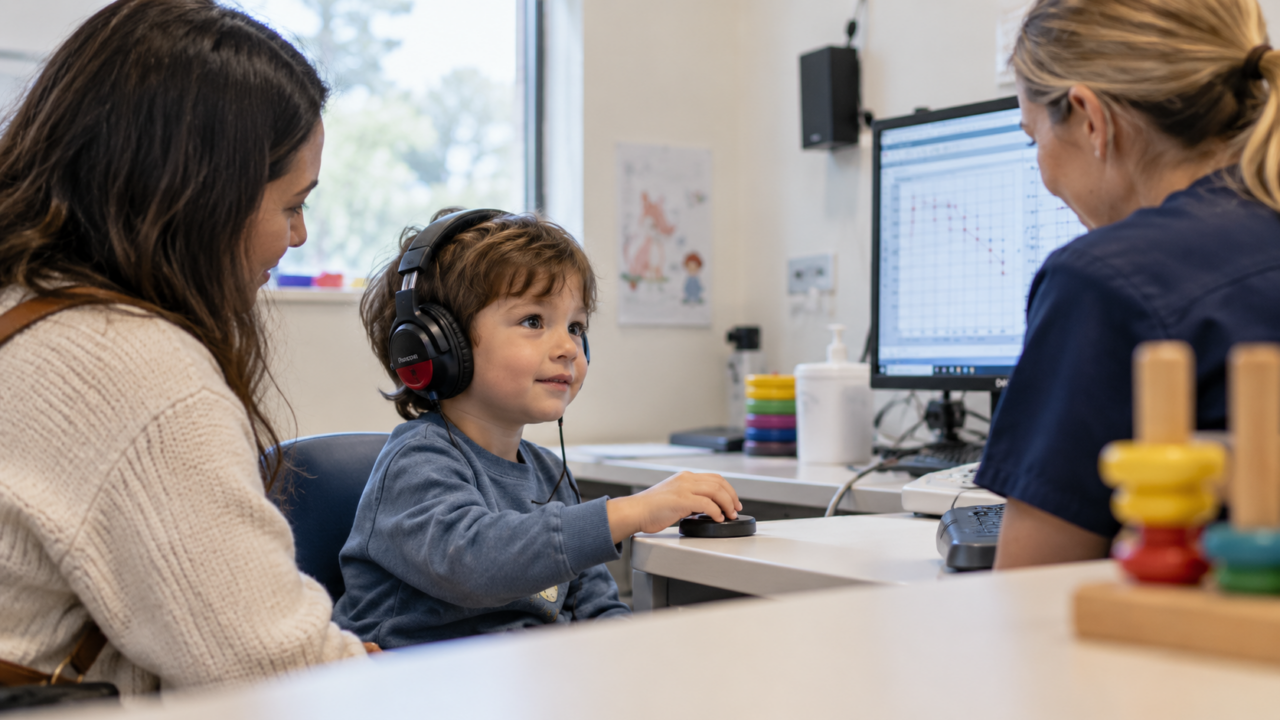
Watchful waiting for otitis media with effusion — also called OME monitoring, observation for middle ear fluid, or the watch-and-wait approach for glue ear — is a structured period of active monitoring during which middle ear fluid, hearing, and daily functioning are observed before any medical or surgical intervention is considered.
What Does Watchful Waiting Mean for Otitis Media With Effusion?
Watchful waiting for OME means monitoring middle ear fluid, hearing, and symptoms for a defined period before deciding whether further treatment is needed — giving the fluid time to clear naturally while tracking whether it is affecting the child’s daily life.
OME is fluid behind the eardrum without active infection. It does not cause fever or significant ear pain, and it does not require antibiotics — because the fluid is not necessarily infected. This distinguishes OME watchful waiting from the shorter 48–72 hour observation period used for a mild acute ear infection.
During the monitoring period, the child’s hearing, communication, school functioning, and ear symptoms are observed. The goal is to answer two questions: is the fluid clearing, and is it affecting the child in ways that justify moving to intervention?
Bottom line: watchful waiting for OME is a clinical strategy, not a delay. It is the recommended first step for most children because most middle ear fluid resolves without treatment.
How long is watchful waiting for otitis media?
Watchful waiting for otitis media with effusion typically lasts three months from the known start of fluid, or three months from the date of diagnosis if onset is unknown.
This three-month window is recommended by both the AAO-HNSF 2016 Clinical Practice Guideline on Otitis Media with Effusion and NICE NG233 (2023). It reflects the natural history of OME — most self-limiting episodes resolve within this window, while fluid that persists beyond three months is significantly less likely to clear spontaneously. A meta-analysis (Rosenfeld & Kay, Laryngoscope 2003) found that chronic OME resolves in only about one in three children within a year.
After three months of persistent fluid with documented hearing loss, a formal hearing evaluation and discussion of treatment options — including tympanostomy tubes — is appropriate.
Watchful waiting may be shorter or skipped entirely for children considered at increased developmental risk: those with Down syndrome, cleft palate, autism spectrum disorder, permanent hearing loss, or existing speech and language delays. These children require earlier evaluation regardless of how long fluid has been present.
What should parents monitor during watchful waiting?
During watchful waiting for OME, track changes in hearing, communication, ear comfort, and daily functioning — specifically, repeated behaviors that differ from what is normal for your child.
The most useful observations are specific and dated. “My child doesn’t seem to hear well” gives a clinician very little to work with. “My child has been asking for repetition at least twice at every meal, turns the TV up every evening, and missed his teacher’s instructions three times this week” gives them something actionable.
Things worth recording: asking for repetition more than usual; turning the TV or tablet volume up; not responding when called from another room; ear pressure, fullness, or popping (particularly after colds); hearing that varies noticeably day to day; frustration or tiredness after school or noisy activities; and any feedback from teachers about missed instructions or classroom participation.
A brief note once or twice a week — with the date, the situation, and whether things seem to be improving or worsening — is more useful than trying to document everything and more realistic to maintain over three months.
How can hearing changes show up during watchful waiting?
Middle ear fluid makes sounds quieter and less distinct — on average reducing hearing by 10 to 15 decibels, though the range extends to 45 decibels in more significant cases. A child who hears fine at home in a quiet room may be struggling significantly in a noisy classroom.
Because OME fluctuates, hearing can vary from day to day as fluid levels and middle ear pressure change. Parents may notice a child who seems to hear well on a quiet weekend but struggles to follow instructions at school on Monday. This inconsistency is characteristic of OME — not behavior, not inattentiveness, not selective listening.
The hearing loss tends to be most apparent when the speaker is at a distance, when there is background noise, or when the child cannot see the speaker’s face. A child who relies on lip-reading and face-watching to fill in the gaps they are missing is working much harder than their behavior suggests — and the fatigue from that effort often shows up as frustration or disengagement later in the day.
What happens at follow-up appointments?
At a follow-up appointment during watchful waiting, the clinician checks whether the fluid is clearing and whether it is affecting hearing or daily life — typically through an ear examination, tympanometry, and age-appropriate hearing testing.
Tympanometry measures eardrum movement in response to pressure changes and is reliable even in young children. It complements but does not replace a formal hearing test in documenting the degree of hearing loss.
Make the appointment more useful by bringing your symptom notes with specific examples and dates, any teacher feedback, results from school hearing screenings, and questions about whether a referral to audiology or ENT is appropriate. If fluid has been present for three months, ask specifically about a formal hearing evaluation — AAO-HNSF guidelines recommend this when OME persists for three months or longer.
What options may be discussed if fluid does not clear?
If middle ear fluid persists beyond three months with documented hearing loss, the AAO-HNSF guideline recommends offering tympanostomy tube insertion as part of a shared decision-making conversation — not automatically, but as an option to discuss based on the child’s individual circumstances.
Before that point, non-surgical options can be used actively during the watchful waiting period. The AAO-HNSF 2016 guideline endorses autoinflation of the Eustachian tube as the only non-surgical intervention specifically recommended during OME surveillance.
Earflo uses swallow-coordinated autoinflation — delivering a gentle puff of air precisely when the Eustachian tube is already opening naturally during swallowing. This targets the negative middle ear pressure and fluid accumulation directly, without forcing pressure against a closed tube. Two published clinical studies (Soto et al., OTO Open 2025; Hura et al., American Journal of Otolaryngology 2026) confirm 99% compliance across four weeks of twice-daily home use, an average 12.9–14.2 dB hearing improvement at two weeks, 91% tympanometric improvement during active use, and 89% of children avoiding tympanostomy tube surgery. No adverse events were reported.
For children in the watchful waiting window, using Earflo twice daily during the monitoring period means the observation period becomes active rather than passive — you are treating the underlying pressure problem while waiting to see whether the fluid resolves.
When to contact your doctor before the next scheduled appointment
Contact your healthcare provider before the next scheduled visit if hearing worsens noticeably, if teachers are repeatedly raising concerns, or if your child shows signs of an acute ear infection.
Seek earlier review if you notice: persistent or worsening hearing difficulty; repeated teacher or caregiver concerns; a failed school hearing screening; speech or language regression; new or significant ear pain; ear discharge; fever or acute illness; or new balance problems.
You do not need to wait for a fixed date if something has clearly changed. The watchful waiting window is a guide, not a constraint. Clinical judgement — and parental instinct — should drive the timing of follow-up when the picture changes.
How Earflo Supports Children During Watchful Waiting for Ear Pressure and Fluid
Watchful waiting asks parents to observe and monitor — but it does not have to mean doing nothing about the underlying problem. The AAO-HNSF 2016 Clinical Practice Guideline on Otitis Media with Effusion specifically endorses autoinflation of the Eustachian tube during the watchful waiting period, making it the only non-surgical home intervention the guideline recommends during surveillance.
Earflo is an FDA-cleared swallow-coordinated autoinflation device designed for children from age two. Unlike conventional devices that apply pressure against a closed Eustachian tube — requiring forceful blowing, causing discomfort, and carrying aspiration risk — Earflo delivers a gentle, controlled puff of air precisely during the natural opening of the Eustachian tube that occurs with every swallow. Because the tube is already opening, less pressure is needed, there is minimal sensation, and the mechanism is safe for young children.
Earflo is used twice daily as part of a morning and evening routine. The form factor resembles drinking from a cup — which is why compliance in clinical studies has been consistently high, even in children as young as two.
Two published clinical studies have evaluated Earflo in children with OME, including children who had already met the criteria for tympanostomy tube surgery:
Soto et al., OTO Open (2025): 99% objective compliance over four weeks of twice-daily home use; 14.2 dB average hearing improvement at two weeks; 89% of children avoided ear tube surgery; no adverse events.
Hura et al., American Journal of Otolaryngology (2026): 99% median compliance; 12.9 dB average hearing improvement at two weeks; 91% of ears showed tympanometric improvement during active device use; 89% of children avoided tympanostomy tubes; no adverse events.
For families in the watchful waiting period, this means the three months of observation can be three months of active treatment — addressing the negative middle ear pressure and fluid accumulation directly. Rather than waiting to see whether the problem resolves, Earflo gives parents something evidence-based to do about it.
[Learn more about Earflo]
Key takeaways
- Watchful waiting for OME is a defined three-month monitoring period — not passive neglect. It is the guideline-recommended first step for most children without developmental risk factors or significant hearing loss
- Most OME resolves naturally within three months. Once fluid has been present for three months, only about one in three children resolve spontaneously within a year
- Track specific, dated observations at home — not general impressions. These are more useful to your clinician than anything visible in a ten-minute appointment
- Hearing loss from OME fluctuates. One good day does not mean the problem has resolved. Pattern over time is what matters
- The AAO-HNSF guideline endorses autoinflation as the only non-surgical home intervention during watchful waiting. Earflo is FDA-cleared from age two, with 99% compliance and 89% surgery avoidance across two published studies
- Contact your doctor before the next scheduled visit if hearing worsens, teachers raise repeated concerns, or your child shows signs of acute infection
About the Author
Dr. Peter Santa Maria, MD, PhD
Professor & Division Chief of Otology and Neurotology
Vice Chair of Translational and Clinical Research, University of Pittsburgh
Dr. Santa Maria is an ear surgeon-scientist specializing in advanced ear disease, hearing loss, and Eustachian tube disorders. He is the principal investigator of the two published clinical studies on swallow-coordinated autoinflation cited in this article, and co-founder and Chief Medical Officer of Earflo, Inc.
Disclosure: Dr. Santa Maria is a co-inventor of Earflo and holds equity in the company.