 Dr Peter Santa Maria, MD, PhD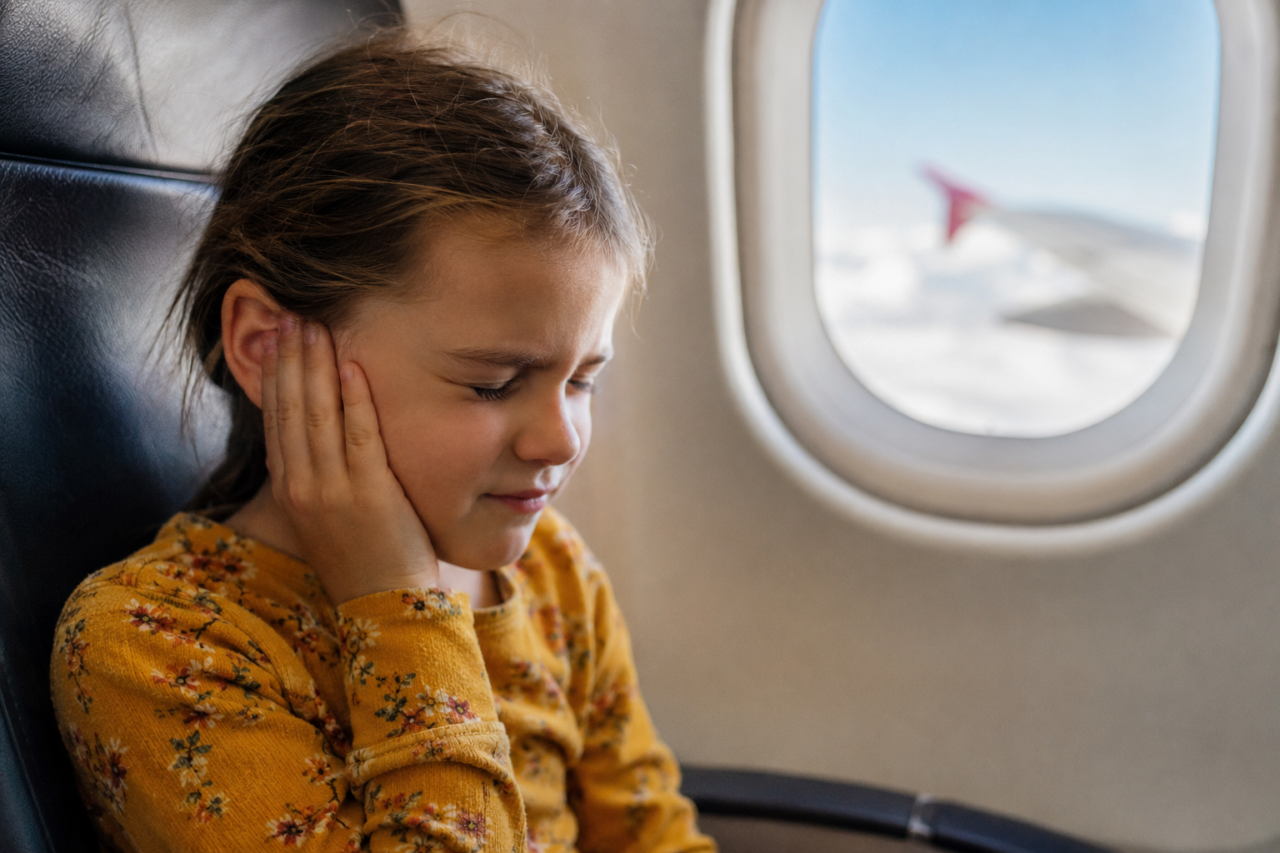
Airplane ear affects millions of passengers — and the standard advice often falls short
Ear pain and pressure during air travel is one of the most common complaints in aviation medicine. A clinical study of passengers across eight commercial flights found otoscopic signs of barotitis — middle ear injury from pressure — in 22% of children and 10% of adults after landing. Negative middle ear pressure significant enough to cause discomfort was present in 40% of children and 20% of adults post-flight.
For most people, the discomfort is temporary. For families traveling with young children who have Eustachian tube dysfunction (ETD) or a history of otitis media with effusion (OME), it can be genuinely painful and disruptive. For frequent flyers with chronic ETD, it may be a recurring problem that affects every journey.
The standard advice — pinch your nose and blow, chew gum, give the baby a bottle — works for many, but not for everyone. And some commonly recommended techniques carry risks that are rarely discussed. This article explains the physiology of airplane ear, evaluates each approach honestly, and explains why swallow-synchronized autoinflation is the most physiologically sound solution available today for both children and adults.
What is airplane ear — and why does it happen?
Airplane ear (also called otic barotrauma, barotitis media, or aerotitis media) occurs when cabin air pressure changes faster than the Eustachian tube can equalize middle ear pressure. The result is a pressure differential across the eardrum — inward displacement during descent, outward during ascent — causing ear pain, muffled hearing, and a sensation of fullness.
Commercial aircraft cabins are pressurized to the equivalent of approximately 6,000–8,000 feet above sea level during cruising altitude. As the plane descends, cabin pressure rises toward ground level. The middle ear — an air-filled space behind the eardrum — needs to equalize to match that rising pressure. Under normal circumstances, brief openings of the Eustachian tube during swallowing allow air to flow in, equalizing pressure with a pop.
The problem arises when the Eustachian tube cannot open quickly or frequently enough to keep up with the rate of pressure change. As cabin pressure rises during descent, the increasing external pressure compresses the soft tissue around the Eustachian tube, making it progressively harder to open — a positive-feedback cycle that explains why ear pain intensifies in the final minutes before landing.
Children are disproportionately affected. Their Eustachian tubes are shorter, narrower, and oriented more horizontally than in adults, making passive ventilation less efficient. Children also cannot reliably execute the Valsalva maneuver that adults use as a fallback. Infants cannot equalize on demand at all — their only mechanism is swallowing during feeding, which is why feeding during descent is clinically recommended.
For passengers with pre-existing ETD, OME, active upper respiratory infections, allergies, or enlarged adenoids, the problem is compounded. Mucosal swelling narrows an already narrow tube, and the cascade of pressure-related discomfort is harder to interrupt.
Who is most at risk for airplane ear?
Airplane ear affects passengers of all ages, but certain groups experience it more severely or more frequently:
- Infants and toddlers: Immature, horizontal Eustachian tubes and an inability to equalize on demand make infants highly vulnerable. The characteristic crying during descent is almost always pressure-related.
- Children with OME or ETD: Fluid already present in the middle ear significantly reduces Eustachian tube compliance, making pressure equalization during descent difficult or impossible.
- Passengers flying with a cold or active nasal congestion: Upper respiratory infection causes mucosal swelling that narrows the Eustachian tube opening. This is when airplane ear most commonly progresses from discomfort to genuine pain.
- Adults with chronic ETD: Patients who already have difficulty with routine pressure equalization — at ground level — face compounded difficulty during altitude changes.
- Patients post-ear surgery or with tympanic membrane abnormalities: Structural changes to the middle ear reduce the margin for safe pressure variation.
- Frequent flyers: Repeated Valsalva maneuvers over years, performed forcefully, carry cumulative risks described below.
Common approaches — and their limitations
Valsalva maneuver: the standard advice with real risks
The Valsalva maneuver — exhaling against a pinched nose with the mouth closed — raises nasopharyngeal pressure until it overcomes Eustachian tube resistance and forces air into the middle ear. It is the most widely recommended technique and can provide rapid pressure relief when performed correctly.
The limitations in air travel are clinically relevant:
- The technique requires a cooperative patient — it cannot be reliably taught to children under five, and infants cannot perform it at all
- The pressure delivered is uncontrolled and user-dependent — too little and it fails; too much and it can over-pressurize the middle ear
- During descent, increasing cabin pressure compresses the Eustachian tube, progressively raising the force required — meaning later in descent, more force is needed at exactly the wrong time
- Habitual forceful Valsalva over many flights has been associated with eardrum stretching and increased susceptibility to atelectasis — the opposite of the intended effect
- It is contraindicated in passengers with active upper respiratory infection, high blood pressure, or cardiovascular conditions
For children and adults who find the Valsalva unreliable, it is often performed more forcefully in frustration — increasing all of the above risks.
Chewing gum, yawning, and swallowing
These approaches exploit the same physiological mechanism as swallow-synchronized autoinflation: swallowing activates the muscles that open the Eustachian tube. They are safe, appropriate for all ages, and should always be the first line of management during ascent and descent.
The limitation is that passive swallowing may not generate sufficient frequency or pressure differential to overcome the progressive external pressure compression during rapid descent, particularly in children with ETD or congestion. They are most effective as prevention during early descent, less effective as rescue once significant pressure has built up.
Decongestant medications: what works, for whom, and when
Decongestants reduce mucosal swelling around the Eustachian tube opening, improving the tube’s ability to equalize pressure. The evidence is nuanced — benefits are real for adults in specific circumstances, negligible for children.
Pseudoephedrine (Sudafed) — adults:
Two randomized controlled trials have evaluated 120 mg oral pseudoephedrine taken 30 minutes before flight. Csortan et al. (1994, n=250) found a reduction in barotrauma symptoms from 62% in the placebo group to 32% (RRR 52%). Jones et al. (1998, n=150) confirmed these findings in a three-arm trial also comparing oxymetazoline, finding a reduction from 71% (placebo) to 34% with pseudoephedrine. Both represent meaningful, statistically significant benefit. Timing matters: it should be taken at least 30 minutes before the flight begins, not just before descent. Pseudoephedrine is available over the counter as Sudafed. Sudafed is contraindicated in people with high blood pressure, heart disease, thyroid disease, anxiety disorders, or pregnancy. Ask your clinician if unsure.
Oxymetazoline (Afrin nasal spray) — adults:
Evidence is less convincing. In the same adult RCT, topical oxymetazoline taken 30 minutes before descent did not achieve statistical significance compared to placebo (64% vs 71% with symptoms). However, timing may matter — some ENTs recommend two puffs per nostril approximately one hour before takeoff and again 30 minutes before descent, giving the spray more time to decongest the Eustachian tube orifice. Critical limitation: do not use Afrin for more than 3 consecutive days — rebound congestion (rhinitis medicamentosa) can develop quickly and leave you worse off. It is not a solution for frequent flyers or multi-day travel.
Decongestants in children — not recommended:
An RCT of pseudoephedrine in children found no reduction in in-flight ear pain, and the drug was associated with drowsiness. Over-the-counter decongestants including Sudafed and Afrin are not recommended for children under 12. For young children, the appropriate pre-flight approach is nasal clearance with saline — not medication.
Pressure-equalizing flight earplugs
Pressure-equalizing flight earplugs contain a small ceramic or mechanical filter that slows the rate at which cabin pressure change reaches the eardrum. By spreading the pressure change over a longer window, they give the Eustachian tube more time to equalize naturally. They are sold at most drugstores and airports.
Evidence is mixed. A controlled study found that pressure-equalizing earplugs did not prevent barotrauma on descent from 8,000 ft cabin altitude in adults, while a pressure chamber study showed modest pain reduction. The Mayo Clinic recommends them as a supplementary measure. They are available at most drugstores and airports.
The key limitation is that they are passive — they do not assist Eustachian tube opening and cannot overcome significant ETD or OME-related obstruction. They work best as a complement to active equalization rather than a standalone solution. Child-specific sizes are available for children aged 3 and older. Earplugs must be inserted before takeoff — they must be in place before pressure changes begin, not inserted reactively once pain has started.
Why general autoinflation devices and maneuvers fall short at altitude
The Valsalva maneuver, nasal balloon devices, and external pressurization devices all share a common mechanical problem: they attempt to force air through a Eustachian tube that is closed. On the ground, that resistance is manageable. During flight descent, the problem is compounded — and these approaches become progressively less effective and more uncomfortable at precisely the wrong moment.
The descent compression problem
As a plane descends, cabin air pressure rises. That rising external pressure acts on the soft tissue surrounding the Eustachian tube, physically compressing it from the outside. The tube becomes harder and harder to force open. The very moment passengers feel the most ear pressure — the last 10–15 minutes before landing — is when conventional approaches require the most force and deliver the least reliable result.
Any technique that depends on overcoming a closed, externally compressed Eustachian tube runs directly against this physiology. The harder you try, the more pressure is required, and the more uncomfortable the attempt.
The Valsalva maneuver
The Valsalva maneuver forces air against a closed Eustachian tube using elevated nasopharyngeal pressure. On an airplane in descent, the tube is already compressed by rising cabin pressure — meaning the Valsalva must be performed harder and harder as the flight progresses, at exactly the time when over-pressurization risk is highest.
Even when it works, the Valsalva delivers an uncontrolled pressure spike into the middle ear. That sudden equalization — air rushing in when the tube finally gives way — produces the familiar painful pop. For passengers with ETD or fluid in the ear, that pop can be genuinely painful rather than merely sharp. For children, who cannot regulate the force of the maneuver reliably, the Valsalva is essentially unusable.
Performed repeatedly and forcefully across multiple flights, the Valsalva also stretches the eardrum over time — progressively reducing its stiffness and increasing susceptibility to the retraction and atelectasis it is meant to prevent.
Nasal balloon devices
Nasal balloon devices work on the same principle as the Valsalva — the user generates positive nasopharyngeal pressure by blowing against a balloon’s resistance. The pressure required to inflate the balloon against a closed, descent-compressed Eustachian tube is high and uncontrolled. Compliance in young children is poor. The balloon provides no feedback on whether the Eustachian tube has opened or been over-pressurized.
A 2018 systematic review of otic barotrauma prevention in aviation (Ryan et al., Otology & Neurotology) concluded that despite some positive findings in individual studies, overall evidence quality was insufficient to support a firm recommendation for nasal balloon inflation — reflecting limitations in study design rather than an absence of any signal.
External nasal pressurization devices
External nasal pressurization devices deliver a puff of pressurized air into the nostril without requiring the patient to blow. This removes the active effort barrier — but retains every other limitation. Pressure is delivered against a closed Eustachian tube. During flight descent, that tube is additionally compressed by rising cabin pressure. The device cannot sense whether the tube is open or closed, cannot detect a swallow, and cannot time its delivery to the brief window when the tube is actively dilating. Any coordination with swallowing must be attempted manually — a caregiver timing a device activation against a child’s unpredictable swallow reflex while managing the nasal interface and the child’s movement, mid-flight.
The result in practice is that the pressure may arrive when the tube is fully closed and compressed, driving against maximum resistance, delivering discomfort without equalization.
The shared problem: pressure against a closed, compressed tube
Every general approach — Valsalva, balloon, pressurization device — applies pressure to a system in a mechanically unfavorable state during descent. The tube is closed. The descent is compressing it further. More force produces more pain, not more reliable opening.
This is the fundamental problem swallow-synchronized autoinflation solves.
Why swallow-synchronized autoinflation is different in the air travel context
Earflo is the only autoinflation device specifically designed to work with the Eustachian tube’s natural opening cycle rather than against a closed tube. By delivering pressure precisely during swallowing — when the tube is already actively dilating — Earflo requires less pressure, causes no painful pop, carries no aspiration risk, and works regardless of how much external pressure is compressing the tube.
The mechanism advantage
The Eustachian tube opens briefly during every swallow — driven by contraction of the tensor veli palatini and levator veli palatini muscles. This opening is not created by pressure overcoming resistance; it is a muscular dilation event. Delivering air during this window requires far less pressure than forcing a closed tube open, produces little to no sensation, and carries no risk of over-pressurization.
In the context of air travel, this mechanism is particularly well-matched to the physiology of descent. As cabin pressure rises, the Eustachian tube becomes progressively harder to force open from the outside — which is why the Valsalva becomes less effective and more forceful as descent continues. Swallow-synchronized autoinflation does not depend on overcoming that resistance: it delivers air during the brief active opening that the tube produces naturally with every swallow, regardless of the external pressure environment.
How Earflo is used during a flight
Earflo delivers a controlled puff of air through a nasal mask timed to the child’s or adult’s natural swallow — in a form factor resembling a cup. Use during air travel is simple:
- Begin during initial descent: Start use as the plane begins descending, before pressure builds — proactive use is more effective than reactive use once pain has started
- Use twice during descent: Two uses spaced through the descent phase are typically sufficient for most passengers
- No technique required: The device detects the swallow and times air delivery automatically — no blowing, no pinching, no coordination with breathing
- Usable from age two: The swallow-triggered mechanism does not require active cooperation beyond drinking from a cup-like device, making it accessible to toddlers
- Infants: For infants under two, feeding during descent remains the recommended approach — breastfeeding, bottle, or pacifier to stimulate natural swallowing
Clinical evidence
Two published clinical studies have evaluated Earflo’s swallow-synchronized autoinflation mechanism in children with OME — the population most vulnerable to airplane ear:
- OTO Open (Soto et al., 2025): At-home feasibility study; 99% objective compliance; 14.2 dB average hearing improvement at 2 weeks; 89% surgery avoidance; no adverse events
- American Journal of Otolaryngology (Hura et al., 2026): Prospective cohort in children already meeting surgical criteria; 99% median compliance; 12.9 dB hearing improvement; 91% tympanometric improvement during active use; 89% avoided tympanostomy tubes; no adverse events
While these studies measured chronic OME outcomes rather than acute flight barotrauma specifically, the underlying mechanism — delivering air pressure during natural Eustachian tube opening — is the same. The consistent 99% compliance rate across both studies reflects the practical advantage of a device that integrates naturally into a normal routine, whether at home or on a flight.
How to prevent airplane ear: a practical guide for before, during, and after the flight
Before the flight — children
- Children with known ETD or OME: Use Earflo twice daily in the 3–5 days leading up to travel — consistent pre-flight use helps normalize middle ear pressure before the altitude challenge begins
- Saline nasal rinse: On the morning of the flight, use a saline nasal rinse or spray in both nostrils. This clears mucus and reduces mucosal swelling around the Eustachian tube opening — the single most effective non-medicated pre-flight preparation for children
- Keep nasal passages clear: If your child has allergies, ensure allergy medications are taken on schedule in the days before travel. Nasal inflammation is the most common modifiable factor in pediatric airplane ear
- Avoid flying with active AOM: A middle ear infection under flight pressure is significantly more painful than baseline OME. If your child has had ear pain and fever in the 48 hours before a flight, seek medical clearance first
- Plan around nap schedules: Swallowing drops significantly during sleep. For toddlers who nap on flights, time the flight to minimize overlap with descent, or plan to keep them awake during the last 30 minutes of the journey
Before the flight — adults
- Earflo: Adults with chronic ETD, recurrent airplane ear, or a history of middle ear problems should use Earflo twice daily in the 3–5 days before travel. This helps normalize middle ear pressure before the altitude challenge begins — a proactive approach that complements any medication strategy on the day of the flight
- Pseudoephedrine (Sudafed): If you have a history of significant airplane ear and no cardiovascular contraindications, 120 mg of pseudoephedrine taken at least 30 minutes before the flight has demonstrated a 52% relative reduction in barotrauma symptoms in adult RCTs. Check with your physician if you have high blood pressure, heart conditions, thyroid disease, or take MAOIs
- Oxymetazoline (Afrin): May help if you have nasal congestion that is contributing to ETD. If using, apply two puffs per nostril approximately one hour before takeoff and again 30 minutes before descent rather than just before landing. Do not use for more than 3 consecutive days — rebound congestion can worsen the problem on subsequent flights
- Saline nasal rinse: Effective and side-effect free. A nasal rinse or saline spray 30–60 minutes before boarding helps clear the nasal passage and reduce Eustachian tube obstruction
- Pressure-equalizing flight earplugs: Insert before boarding — they must be in place before pressure changes begin. Filtered flight earplugs are available at most pharmacies and airports
- If flying with a cold: Consider delaying if the congestion is severe. If flying is unavoidable, combine a saline rinse, decongestant nasal spray (if no contraindications), and Earflo during descent
During the flight — all passengers
- Start Earflo at the beginning of descent: Do not wait for pain to develop. Proactive use before pressure has built significantly is more effective than reactive use once the Eustachian tube is compressed
- Swallow frequently: Water, juice, or sweets between Earflo uses — every swallow creates a brief Eustachian tube opening
- Do not sleep through descent: This is one of the most consistently recommended clinical precautions. Swallowing frequency drops dramatically during sleep. The AAO-HNSF explicitly advises against sleeping during descent. Wake children from naps before the final 30 minutes of the flight
During the flight — specific guidance by age
- Infants (under 2): Begin breastfeeding, bottle feeding, or offer a pacifier at the start of descent and maintain throughout. Sucking triggers the swallowing reflex that opens the Eustachian tube. This is the most effective and the only practical approach for infants
- Toddlers and young children (2–5): Earflo from age 2; combine with a sippy cup or drink during descent. Keep them awake and eating or drinking during the descent phase. Chewing a snack also generates swallows
- Older children (6+): Earflo plus active swallowing; if they can learn a gentle Valsalva, it can serve as a backup — but do not encourage forceful technique
- Adults: Earflo plus active swallowing; chewing gum throughout descent is one of the most consistently effective simple strategies; gentle Valsalva if needed — never forceful
- Adults using Afrin: If you applied a second dose of oxymetazoline 30 minutes before descent as recommended, the spray requires approximately 5–10 minutes to reach peak effect — continue swallowing actively during that window
After the flight
- Persistent blockage: If ears remain blocked after landing, a single Earflo use on the ground can help clear residual negative middle ear pressure
- Continue swallowing actively: Yawning, swallowing, and gentle jaw movements in the baggage claim area continue to help equalize residual pressure
- Muffled hearing or pain beyond a few hours: Warrants contact with a clinician — do not assume it will resolve if discomfort is significant or hearing is noticeably muffled the following day
- Children with pre-existing OME: Consider a follow-up appointment after long-haul flights if symptoms appear to worsen after travel
Avoid re-boarding with unresolved severe pain: If pain was significant on the inbound flight, address it before the return journey — do not assume it will be better
When to consult a doctor before flying
Most children and adults with ETD or OME can fly safely with appropriate precautions. However, some situations warrant discussion with a clinician before booking:
- Active AOM (acute otitis media): Flying with an active bacterial ear infection is not recommended — pressure changes can significantly worsen pain and risk tympanic membrane rupture
- Recent tympanic membrane perforation: Any recent perforation requires ENT clearance before flying
- Recent ear surgery: Tympanostomy tube placement, myringoplasty, or other middle ear surgery — discuss timing of air travel with your surgeon
- Severe congestion from a cold: Flying with significant mucosal swelling is uncomfortable and can lead to prolonged post-flight pressure problems. Consider delaying if the cold is at its worst
Children with patent (functioning) tympanostomy tubes in place generally have easier pressure equalization during flight, as the tubes bypass the Eustachian tube entirely.
Frequently asked questions about airplane ear
Why do ears hurt more during landing than takeoff?
During ascent, cabin pressure drops and air escapes the middle ear passively through the Eustachian tube — a process that requires relatively little active effort. During descent, cabin pressure rises and air must actively enter the middle ear through the Eustachian tube to equalize. Additionally, as descent continues, increasing external pressure physically compresses the Eustachian tube, making it progressively harder to open. This is why ear pressure problems are concentrated in the last 10–20 minutes of a flight.
Why do babies cry so much during landing?
Infants cannot equalize middle ear pressure on demand. Their Eustachian tubes are shorter and more horizontal than in adults, passive equalization is less efficient, and they cannot perform intentional equalization techniques. The rapid pressure rise during descent creates a painful inward pressure on the eardrum. Feeding — breastfeeding, bottle, or pacifier — triggers the swallowing reflex that opens the Eustachian tube, which is why feeding during descent reliably helps.
Is it safe for a child with ear tubes to fly?
Generally yes — children with patent tympanostomy tubes in place typically have easier pressure equalization during flights, because the tubes provide an alternative ventilation pathway that bypasses the Eustachian tube. Once tubes have extruded, however, the underlying ETD that led to tube placement may return, and precautions during air travel become relevant again.
Does Earflo work for adults with ETD?
Yes. The swallow-synchronized autoinflation mechanism works on the same physiology in adults as in children. The Eustachian tube opens during swallowing at any age. Published clinical data are currently in children with OME, but the mechanism — pressure delivered during active tube opening — is equally applicable to adults managing chronic ETD or recurrent airplane ear.
Can you use Earflo preventively, before pressure builds?
Yes, and this is the recommended approach. Using Earflo at the start of descent — before significant pressure has accumulated — is more effective than attempting to rescue an already painful ear. The incremental pressure equalization achieved with proactive use prevents the progressive compression cycle that makes descent increasingly difficult.
Should I take Sudafed before flying?
For adults with a history of significant airplane ear and no cardiovascular contraindications: yes, there is good evidence. Two RCTs of 120 mg pseudoephedrine taken 30 minutes before flying found it reduced barotrauma symptoms by roughly half compared to placebo — from 62% to 32% in one study, and from 71% to 34% in another that also confirmed oxymetazoline nasal spray was not statistically better than placebo. It is not appropriate for children under 12, and is contraindicated in people with high blood pressure, heart disease, thyroid conditions, or those taking MAOIs. Check with your physician before using it for the first time.
Does Afrin help with airplane ear?
Afrin (oxymetazoline nasal spray) has a less convincing evidence base — it did not reach statistical significance compared to placebo when taken 30 minutes before descent in the primary adult RCT. Timing likely matters: applying it one hour before takeoff and again 30 minutes before descent gives more time for the spray to decongest the Eustachian tube orifice. It should not be used for more than 3 consecutive days due to rebound congestion risk. It is not appropriate for children under 12.
What about flying with a cold?
Flying with significant nasal congestion makes airplane ear more likely and more severe. If flying is unavoidable: saline nasal rinse before boarding, pseudoephedrine if no contraindications, and proactive Earflo use from the start of descent. If the cold is at its worst with severe congestion, consider delaying travel — the Eustachian tube cannot open effectively through severely swollen mucosa, and the flight will be painful regardless of what you take.
Key takeaways: managing ear pressure during air travel
- Airplane ear affects 10–22% of passengers post-flight — with children significantly more affected than adults due to Eustachian tube anatomy. Children with OME or ETD are at highest risk.
- The Valsalva maneuver is widely recommended but has real limitations: it cannot be performed by young children, is ineffective when congestion is severe, and carries risks with forceful or repeated use.
- Swallowing — whether spontaneous, with food or drink, or coordinated with a device — is the physiologically sound approach because it exploits the natural muscle-driven opening of the Eustachian tube.
- Swallow-synchronized autoinflation delivers air pressure during the brief window when the Eustachian tube is already actively opening, requiring less force, producing no discomfort, and carrying no aspiration risk.
- Earflo is FDA-cleared, usable from age two, and has demonstrated 99% compliance and 89% surgery avoidance across two published clinical studies in children with OME.
- Begin Earflo use at the start of descent, not after pain develops. Proactive use prevents the pressure buildup cycle; reactive use is less effective once the tube is compressed shut.
- Avoid flying with active AOM, recent ear surgery, or significant congestion without clinician guidance.
Try Earflo before your next flight: Learn about Earflo
See Earflo in action: Watch on YouTube
References
1. Stangerup SE, Tjernström O, Klokker M, Harcourt J, Stokholm J. Point prevalence of barotitis in children and adults after flight, and effect of autoinflation. Aviation, Space, and Environmental Medicine. 1998;69(1):45–49. PMID: 9451533.
2. Stangerup SE, Klokker M, Vesterhauge S, Jayaraj S, Rea P, Harcourt J. Point prevalence of barotitis and its prevention and treatment with nasal balloon inflation: a prospective, controlled study. Otology & Neurotology. 2004;25(2):89–94. doi:10.1097/00129492-200403000-00001. PMID: 15021764.
3. Mirza S, Richardson H. Otic barotrauma from air travel. Journal of Laryngology & Otology. 2005;119(5):366–370. doi:10.1258/0022215053945723. PMID: 15949100.
4. Soto MJ, Hura N, Oldakowska I, Oldakowski M, Bumbak P, Santa Maria PL. Feasibility of a Novel Autoinflation Device to Treat Pediatric Otitis Media With Effusion At-Home. OTO Open. 2025;9(2):e70128. doi:10.1002/oto2.70128. PMID: 40370996.
5. Hura N, Soto MJ, Lalwani Z, Oldakowska I, Oldakowski M, Bumbak P, Santa Maria PL. A novel autoinflation device for persistent pediatric otitis media with effusion: A prospective single-arm cohort study. American Journal of Otolaryngology. 2026;47(4):104862. doi:10.1016/j.amjoto.2026.104862. PMID: 42296786.
6. Webster KE, Mulvaney CA, Galbraith K, Rana M, Marom T, Daniel M, Venekamp RP, Schilder AGM, MacKeith S. Autoinflation for otitis media with effusion (OME) in children. Cochrane Database of Systematic Reviews. 2023;(9):CD015253. doi:10.1002/14651858.CD015253.pub2. PMID: 37750500.
7. American Academy of Otolaryngology–Head and Neck Surgery Foundation. Ears and Altitude (Barotrauma). ENThealth.org. Last reviewed August 2018.
8. Jones JS, Sheffield W, White LJ, Bloom MA. A double-blind comparison between oral pseudoephedrine and topical oxymetazoline in the prevention of barotrauma during air travel. American Journal of Emergency Medicine. 1998;16(3):262–264. doi:10.1016/s0735-6757(98)90097-3. PMID: 9596428.
9. Csortan E, Jones J, Haan M, Brown M. Efficacy of pseudoephedrine for the prevention of barotrauma during air travel. Annals of Emergency Medicine. 1994;23(6):1324–1327. doi:10.1016/s0196-0644(94)70359-0. PMID: 8198308.
10. Ryan P, Treble A, Patel N, Jufas N. Prevention of otic barotrauma in aviation: a systematic review. Otology & Neurotology. 2018;39(5):539–549. doi:10.1097/MAO.0000000000001779. PMID: 29595579.
11. Mayo Clinic. Airplane ear (ear barotrauma, barotitis media, aerotitis media). mayoclinic.org. Last updated April 2025.
About the Author
Dr Peter Santa Maria, MD, PhD
Professor & Division Chief of Otology and Neurotology
Vice Chair of Translational and Clinical Research
University of Pittsburgh
Dr Santa Maria is an Ear Nose & Throat (ENT) surgeon-scientist specializing in advanced ear disease, hearing loss, and Eustachian tube disorders.
Disclosure: This article was written in connection with Earflo, an FDA-cleared device for negative middle ear pressure. Dr. Peter Santa Maria is a co-inventor of Earflo and holds equity in the company.